Train DBW11, the Wilson Steel Works local, returns from Dale City...
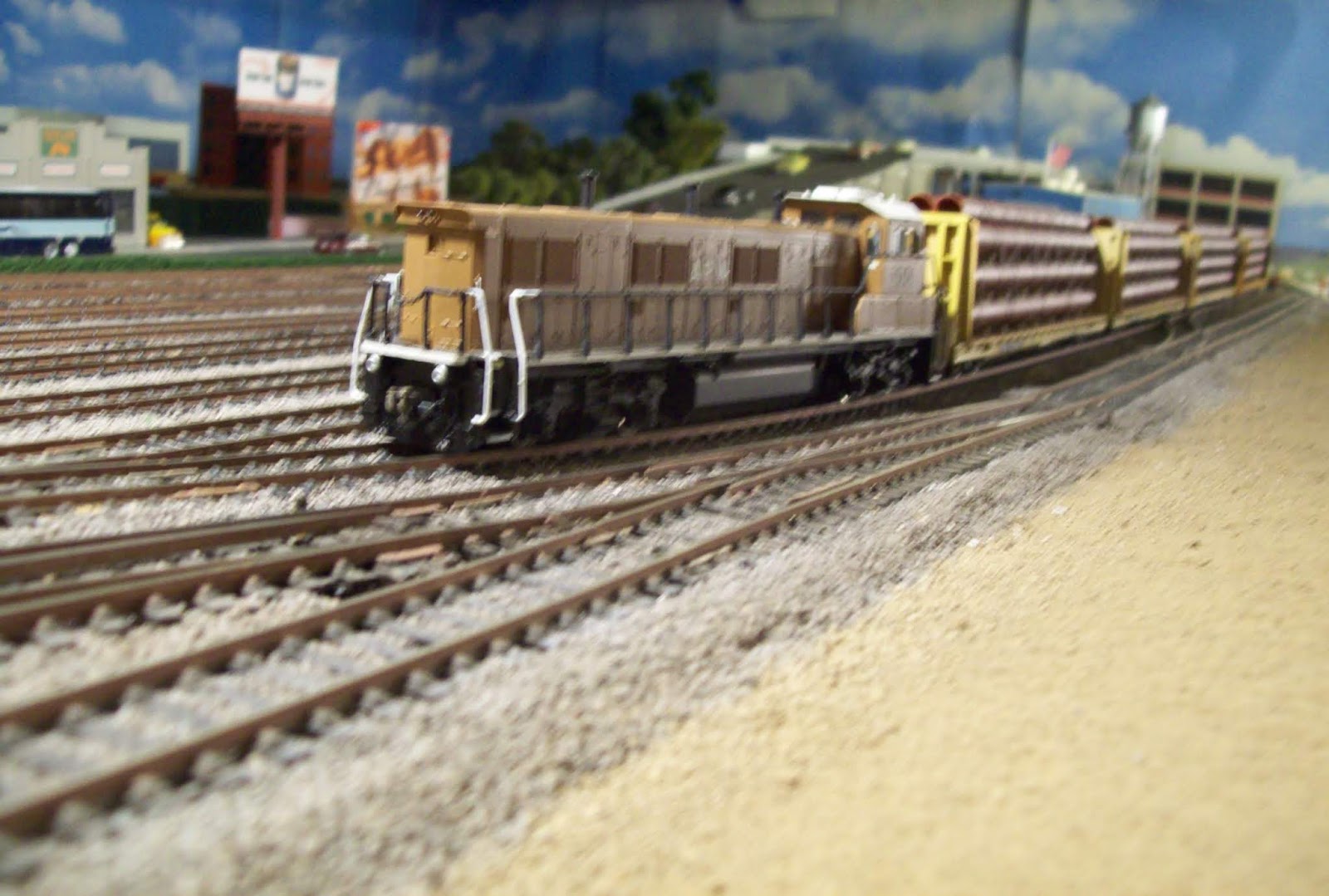
Genset 300 is stopped on the east end of the yard with a string of pipe loads.
A group of workers is gathered around one of the cars, looking at an apparent problem underneath the car.
The problem is with the brake gear; part of it is broken and hanging loose from the car's underbody. The car will be set out in front of the shop for emergency repairs.
A day later, the car has been repaired, and is ready to be sent out to join its fellow cars, already headed west to a new gas pipeline project.
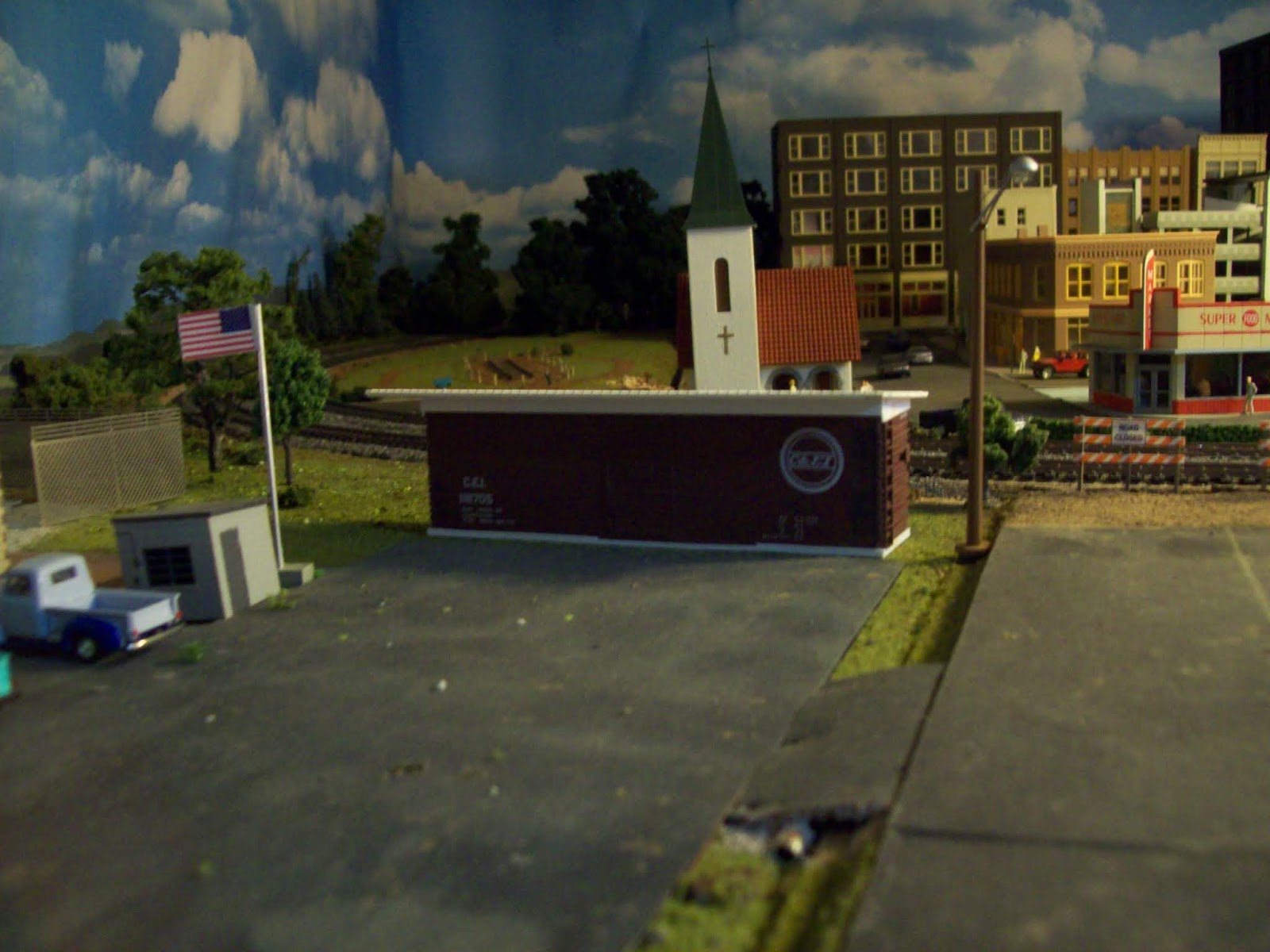
A new project for the layout; a storage building, made from an old surplus boxcar.
Now painted, the building also has rooftop vents installed. The roof overhang provides partial protection for a pair of vending machines.
The "surplus" boxcar is an old Accurail car that I wound up "parting out", thus the extra body shell. The rooftop ventilators are also from Accurail; the truck securing pins found in the kits, which I trimmed down on the ends to provide a flat top. The roof itself is made from left-over roofing material from a Pikestuff building kit. And it all is tied together with Evergreen strip styrene, and Floquil reefer grey paint. The building was inspired by a photo of a similar building along the Rock Island in Mediapolis, Iowa, which was actually the local headquarters! Of course. the real building had windows -one with an a/c unit, an oil tank for heating, and a semaphore by the tracks.
More trains next week; until then, HAPPY THANKSGIVING!
Sunday, November 24, 2019
Sunday, November 17, 2019
THE 60's; PT5
Finishing the train -and the 60's- from last week...
The final set of reefers in the train is this pair of orange ART cars, with the heralds of Norfolk & Western and the Missouri Pacific, two of the owner roads. The N&W inherited its ownership via its purchase and merger with the Wabash in 1964.
After the brightly colored reefers come the more common drab brown boxcars. The first one is a 50' CGW (Chicago Great Western) car with a large "DF" to indicate restraining devices for "Damage-Free" loading. The next three cars are 40' APRR boxcars with two different slogans.
As seen here, not only do the cars have different slogans, but different lettering schemes as well. The car on the right has the "THE ALL-PURPOSE ROAD" slogan, along with APPALACHIAN RR spelled out over the reporting marks; the car on the left has the "ALWAYS PROFESSIONAL SERVICE" slogan, with a small APPALACHIAN at the top corner of the car. As indicated by the different car numbers, these are also two different boxcars; note the different roofs.
Another pair of 50' boxcars, a New York Central car and a Detroit & Toledo Shore Line car. The D&TS served much of the Detroit area auto industry, leading to its slogan "Expressway For Industry". The line was jointly owned by the Grand Trunk Western and the N&W (inherited from the Nickel Plate). GTW bought out the N&W's half in 1981 and merged the D&TS.
A trio of bright, white hopper cars, owned by W.R. Grace & Co., returning to Clifton, NJ.
Another pair of hoppers follow a Hooker Chemicals tank car. The grey hopper is a AP car loaded with corn meal, while the other hopper is an ACF demonstrator.
ACFX 44504 is ACF's (American Car Foundry) demo car, showcasing the advantages of their "Center Flow" concept: by eliminating the center sill underframe, the car now could be unloaded more easily and efficiently, as there were no longer any interior obstructions for the load to catch on. The concept caught on, and the modern covered hopper car -with single full-width hopper outlet gates, instead of twin gates- was born. Bringing up the rear is the traditional red caboose, with the road name stretched across nearly the entire side of the car, and "ALWAYS PROFESSIONAL SERVICE" prominently displayed at the top. 809 is part of the I-9 class of cabooses, and was purchased during the early 50's. The I-9's were a bit shorter than most of the cabooses purchased by the AP, measuring only 32' long; most AP cabooses were 35' long. Nearly 70 years after it was built, 809 lives on as a display piece in a park.
This is probably the last "60's" look at Hillsdale. I've decided to concentrate on the modern era (post 1980's) and so much of the equipment seen these past few weeks will be sold off as time goes on (but not all of it). And so, back to the present time next week!
The final set of reefers in the train is this pair of orange ART cars, with the heralds of Norfolk & Western and the Missouri Pacific, two of the owner roads. The N&W inherited its ownership via its purchase and merger with the Wabash in 1964.
After the brightly colored reefers come the more common drab brown boxcars. The first one is a 50' CGW (Chicago Great Western) car with a large "DF" to indicate restraining devices for "Damage-Free" loading. The next three cars are 40' APRR boxcars with two different slogans.
As seen here, not only do the cars have different slogans, but different lettering schemes as well. The car on the right has the "THE ALL-PURPOSE ROAD" slogan, along with APPALACHIAN RR spelled out over the reporting marks; the car on the left has the "ALWAYS PROFESSIONAL SERVICE" slogan, with a small APPALACHIAN at the top corner of the car. As indicated by the different car numbers, these are also two different boxcars; note the different roofs.
Another pair of 50' boxcars, a New York Central car and a Detroit & Toledo Shore Line car. The D&TS served much of the Detroit area auto industry, leading to its slogan "Expressway For Industry". The line was jointly owned by the Grand Trunk Western and the N&W (inherited from the Nickel Plate). GTW bought out the N&W's half in 1981 and merged the D&TS.
A trio of bright, white hopper cars, owned by W.R. Grace & Co., returning to Clifton, NJ.
Another pair of hoppers follow a Hooker Chemicals tank car. The grey hopper is a AP car loaded with corn meal, while the other hopper is an ACF demonstrator.
ACFX 44504 is ACF's (American Car Foundry) demo car, showcasing the advantages of their "Center Flow" concept: by eliminating the center sill underframe, the car now could be unloaded more easily and efficiently, as there were no longer any interior obstructions for the load to catch on. The concept caught on, and the modern covered hopper car -with single full-width hopper outlet gates, instead of twin gates- was born. Bringing up the rear is the traditional red caboose, with the road name stretched across nearly the entire side of the car, and "ALWAYS PROFESSIONAL SERVICE" prominently displayed at the top. 809 is part of the I-9 class of cabooses, and was purchased during the early 50's. The I-9's were a bit shorter than most of the cabooses purchased by the AP, measuring only 32' long; most AP cabooses were 35' long. Nearly 70 years after it was built, 809 lives on as a display piece in a park.
This is probably the last "60's" look at Hillsdale. I've decided to concentrate on the modern era (post 1980's) and so much of the equipment seen these past few weeks will be sold off as time goes on (but not all of it). And so, back to the present time next week!
Sunday, November 10, 2019
THE 60'S PT4
Now that we've seen the yard, let's see a train!
Train PN70MX, the Pittsburgh-New York City Merchandise Express train, rolls into town behind a pair of EMD GP35's. The head-end is comprised of meat reefers loaded with pork, beef and poultry headed to Northeastern markets for the upcoming holiday season.
The 4-axle engines pass their larger 6-axle brethren as they speed the hotshot freight through the yard. Even though mechanical reefer cars are showing up in ever increasing numbers, the reefers in this train are still ice-cooled -meaning there is an increased need for expediency, as the reefers will not be re-iced before arriving in New York City.
The first of the reefers are these four Armour cars. Note the first car has a black roof and ends, while the other three are solid yellow.
The next group are these Hormel cars, leased from North American Car Co.
A set of reefers leased by Dugdale Packing of St. Joseph, Mo. from UTLX.
Another set of UTLX reefers, this time leased by Bookey Packing Co. of Des Moines, Iowa.
More Midwestern cars; Central Packing Co., Inc. of Kansas City, Mo. These cars are leased from the American Refrigerator Transit Co. (ART).
Next week; the rest of the train.
Train PN70MX, the Pittsburgh-New York City Merchandise Express train, rolls into town behind a pair of EMD GP35's. The head-end is comprised of meat reefers loaded with pork, beef and poultry headed to Northeastern markets for the upcoming holiday season.
The 4-axle engines pass their larger 6-axle brethren as they speed the hotshot freight through the yard. Even though mechanical reefer cars are showing up in ever increasing numbers, the reefers in this train are still ice-cooled -meaning there is an increased need for expediency, as the reefers will not be re-iced before arriving in New York City.
The first of the reefers are these four Armour cars. Note the first car has a black roof and ends, while the other three are solid yellow.
The next group are these Hormel cars, leased from North American Car Co.
A set of reefers leased by Dugdale Packing of St. Joseph, Mo. from UTLX.
Another set of UTLX reefers, this time leased by Bookey Packing Co. of Des Moines, Iowa.
More Midwestern cars; Central Packing Co., Inc. of Kansas City, Mo. These cars are leased from the American Refrigerator Transit Co. (ART).
Next week; the rest of the train.
Sunday, November 3, 2019
THE 60's PT3
Now, the west end of the yard...
The west end has a few cars present, including a caboose, as well as some spare rails sitting on the ground.
The green car is a DT&I (Detroit, Toledo & Ironton) boxcar with a Hydrocushion underframe; this helps reduce the "slack action" from starts and stops, which in turn reduces the potential damage to the cargo. Given that the DT&I moved a lot of auto parts to the Ford plants in and around Detroit, these cars were put to good use. The black and silver car is a Central of Georgia car in the famous "blimp" scheme. The caboose is adorned with a then-new ACI (Automated Car Identifier) label. Introduced in 1967, these were the railroads' early attempt at trackside scanning for tracking purposes by computers. Of course, the labels needed to be clean in order for the scanners to read them -and freight cars don't get washed! Not surprisingly, the railroads abandoned the effort after about a decade of trying -but the labels lasted on car sides for decades afterwards!
The middle car of a three car set of pulpwood flats is seen here, they are empty, headed back to a logging spur for more pulpwood to deliver to the paper mill in Dale City. At this time, as the area forests were logged, the smaller trees and brush were trucked to a spur and loaded on these cars. Nowadays, the "small stuff" gets ground up into wood chips and loaded in large hoppers and gondolas. APRR 9247 and her sisters were built in the 1930's, and still have their original Andrews trucks; since the selling point of the Andrews was the ability to re-use the journal boxes from obsolete arch-bar trucks (they are bolted on in both cases), those journal boxes are probably pretty old by now!
A pair of hoppers; one a three-bay Pillsbury car, the other a black two-bay CGW (Chicago Great Western) car. In another two years, the CGW will be owned by the APRR -to the chagrin of the CNW!
Back at the east end, another future merger acquisition the Monon, is represented by a new PS-1 boxcar, without a roof walk. The silver car is an Atlanta & West Point car. It must be a warm day -note the Lincoln Continental has its top down!
The four L&N boxcars seen last week are on the back track, for a comparison of their paint schemes. The SD35's are beside them, and the front row is all 40' boxcars; (l to r) Atlantic & East Carolina, Seaboard Air Line, Tennessee Central, and the TA&G. The Tennessee Central was in bad shape by this time; it had only posted a profit twice in the previous decade and will soon be abandoned. The Atlantic & East Carolina was purchased by the Southern in 1956, while the Seaboard Air Line, the L&N and the Atlanta & West Point are all now part of CSX.
Next week: we've had a look at the yard traffic, now let's watch a train!
The west end has a few cars present, including a caboose, as well as some spare rails sitting on the ground.
The green car is a DT&I (Detroit, Toledo & Ironton) boxcar with a Hydrocushion underframe; this helps reduce the "slack action" from starts and stops, which in turn reduces the potential damage to the cargo. Given that the DT&I moved a lot of auto parts to the Ford plants in and around Detroit, these cars were put to good use. The black and silver car is a Central of Georgia car in the famous "blimp" scheme. The caboose is adorned with a then-new ACI (Automated Car Identifier) label. Introduced in 1967, these were the railroads' early attempt at trackside scanning for tracking purposes by computers. Of course, the labels needed to be clean in order for the scanners to read them -and freight cars don't get washed! Not surprisingly, the railroads abandoned the effort after about a decade of trying -but the labels lasted on car sides for decades afterwards!
The middle car of a three car set of pulpwood flats is seen here, they are empty, headed back to a logging spur for more pulpwood to deliver to the paper mill in Dale City. At this time, as the area forests were logged, the smaller trees and brush were trucked to a spur and loaded on these cars. Nowadays, the "small stuff" gets ground up into wood chips and loaded in large hoppers and gondolas. APRR 9247 and her sisters were built in the 1930's, and still have their original Andrews trucks; since the selling point of the Andrews was the ability to re-use the journal boxes from obsolete arch-bar trucks (they are bolted on in both cases), those journal boxes are probably pretty old by now!
A pair of hoppers; one a three-bay Pillsbury car, the other a black two-bay CGW (Chicago Great Western) car. In another two years, the CGW will be owned by the APRR -to the chagrin of the CNW!
Back at the east end, another future merger acquisition the Monon, is represented by a new PS-1 boxcar, without a roof walk. The silver car is an Atlanta & West Point car. It must be a warm day -note the Lincoln Continental has its top down!
The four L&N boxcars seen last week are on the back track, for a comparison of their paint schemes. The SD35's are beside them, and the front row is all 40' boxcars; (l to r) Atlantic & East Carolina, Seaboard Air Line, Tennessee Central, and the TA&G. The Tennessee Central was in bad shape by this time; it had only posted a profit twice in the previous decade and will soon be abandoned. The Atlantic & East Carolina was purchased by the Southern in 1956, while the Seaboard Air Line, the L&N and the Atlanta & West Point are all now part of CSX.
Next week: we've had a look at the yard traffic, now let's watch a train!
Sunday, October 27, 2019
THE 60's; PT2
More of the 60's...
A worker stands next to an old Dodge Power Wagon converted to a rail truck; note the regular wheels have been replaced with rail wheels. The highway wheels are in the bed. This was in the days before the creation of the "hi-rail" wheels, which allow much easier conversions between road and rail.
A Mack H-61 cab-over sits with a 40' drop-deck trailer advertising the APRR's piggyback service. During the late 60's, and into the late 70's, drop-deck trailers were popular with the railroads and many shippers (especially UPS) as a way to increase cargo capacity, since trailers were limited by law to 40' in length. With the legal length increased to 45', then 48' during the 80's, drop-decks fell out of favor, and many wound up in storage use, often with one of the two axles removed.
Also of note are the two Ford trucks; one a stake-bed in company service, the other for l.c.l. (less than car-load) service. When freight cars were unloaded at terminals, depots or warehouses these trucks made the final delivery to the customer -and also picked up goods to be shipped out. Today, of course, freight is shipped from point to point in the same trailer or container, minimizing the amount of handling, labor costs -and potential for damage- needed to move goods.
The boxcars on the siding are serving the furniture factory.
Boxcars were still the dominant car, as seen here. The blue TA&G boxcar stands out among the more typical brown cars.
Also of note is this carbon black hopper car. During this time, these cars were rather common in Hillsdale, as they were used not only by local Pete's Plastics, but also common on run-through freights to Cumberland, for the Kelly Tire plant.
The roof of the TA&G (Tennessee, Alabama & Georgia) boxcar is seen here; notice it is not a typical peaked roof, but a flat roof with rounded edges. This is a Pennsylvania Railroad design, the TA&G purchased the car second hand. The "tag" on the car plays to the company's slogan "The TAG Route". Behind it a a red L&N (Louisville & Nashville) boxcar, with the "Dixie Line" slogan, and a grey boxcar in company service.
A pair of SD35's move among the cars. Note the pair of L&N boxcars -this time in blue. They join the two red cars. The red cars are double-door, the blue ones single-door, with "DF" insignias to indicate load restraining devices installed in the cars. Both sets of cars feature one each with one of L&N's two slogans; "The Dixie Line" or "The Old Reliable". The green boxcar is from the Georgia & Florida, and all five cars are 50' Pullman Standard PS1 boxcars.
A further look at Hillsdale Yard (the west end) next week.
A worker stands next to an old Dodge Power Wagon converted to a rail truck; note the regular wheels have been replaced with rail wheels. The highway wheels are in the bed. This was in the days before the creation of the "hi-rail" wheels, which allow much easier conversions between road and rail.
A Mack H-61 cab-over sits with a 40' drop-deck trailer advertising the APRR's piggyback service. During the late 60's, and into the late 70's, drop-deck trailers were popular with the railroads and many shippers (especially UPS) as a way to increase cargo capacity, since trailers were limited by law to 40' in length. With the legal length increased to 45', then 48' during the 80's, drop-decks fell out of favor, and many wound up in storage use, often with one of the two axles removed.
Also of note are the two Ford trucks; one a stake-bed in company service, the other for l.c.l. (less than car-load) service. When freight cars were unloaded at terminals, depots or warehouses these trucks made the final delivery to the customer -and also picked up goods to be shipped out. Today, of course, freight is shipped from point to point in the same trailer or container, minimizing the amount of handling, labor costs -and potential for damage- needed to move goods.
The boxcars on the siding are serving the furniture factory.
Boxcars were still the dominant car, as seen here. The blue TA&G boxcar stands out among the more typical brown cars.
Also of note is this carbon black hopper car. During this time, these cars were rather common in Hillsdale, as they were used not only by local Pete's Plastics, but also common on run-through freights to Cumberland, for the Kelly Tire plant.
The roof of the TA&G (Tennessee, Alabama & Georgia) boxcar is seen here; notice it is not a typical peaked roof, but a flat roof with rounded edges. This is a Pennsylvania Railroad design, the TA&G purchased the car second hand. The "tag" on the car plays to the company's slogan "The TAG Route". Behind it a a red L&N (Louisville & Nashville) boxcar, with the "Dixie Line" slogan, and a grey boxcar in company service.
A pair of SD35's move among the cars. Note the pair of L&N boxcars -this time in blue. They join the two red cars. The red cars are double-door, the blue ones single-door, with "DF" insignias to indicate load restraining devices installed in the cars. Both sets of cars feature one each with one of L&N's two slogans; "The Dixie Line" or "The Old Reliable". The green boxcar is from the Georgia & Florida, and all five cars are 50' Pullman Standard PS1 boxcars.
A further look at Hillsdale Yard (the west end) next week.
Subscribe to:
Posts (Atom)